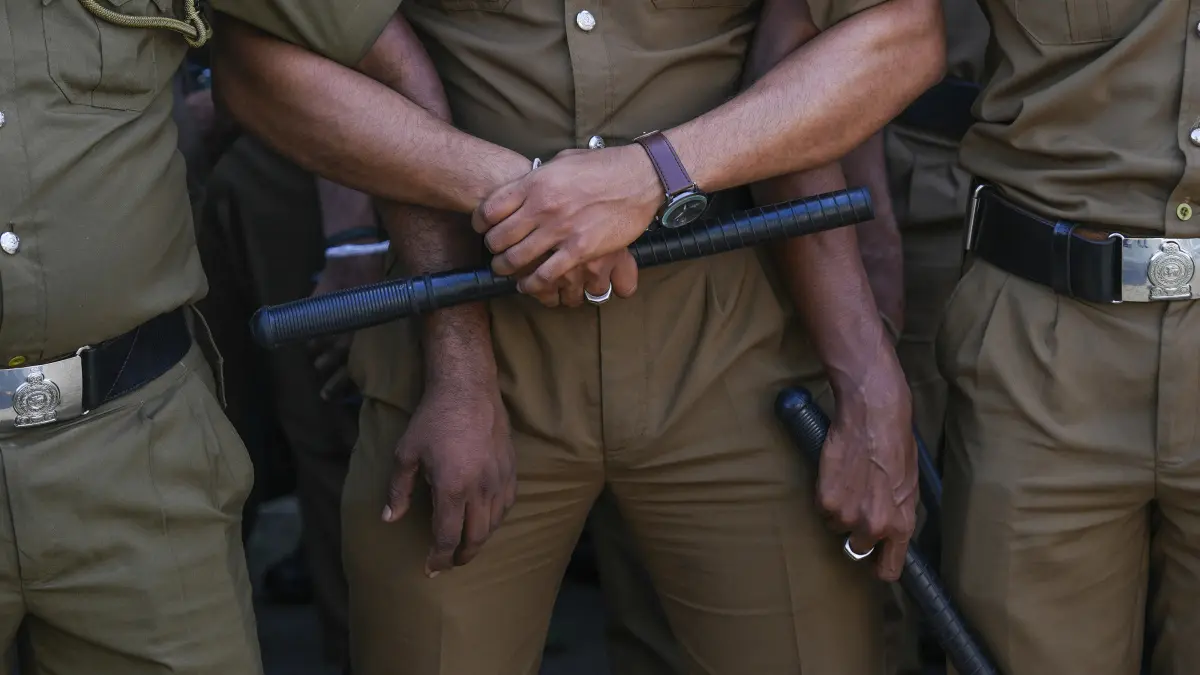
Sri Lanka Counterterrorism Law May Spur More Abuses
The Sri Lanka government’s proposed counterterrorism legislation includes numerous provisions similar to the current abusive law and risks facilitating the same kind of repression, Human Rights Watch said today. The bill does not meet benchmarks set out by the United Nations counterterrorism expert or comply with human rights obligations and commitments that Sri Lanka made to the European Union to benefit from trade arrangements under the Generalized System of Preferences, or GSP+.
The Protection of the State from Terrorism Act (PSTA), published by the Ministry of Justice in December 2025, would replace the draconian Prevention of Terrorism Act (PTA), which has facilitated extensive violations including arbitrary detention and torture since it was introduced in 1979. In 2017, Sri Lanka committed to replace the PTA with human rights-respecting legislation as a condition for the EU to reinstate GSP+, but successive Sri Lankan governments have failed to comply. In his party’s 2024 election manifesto, President Anura Kumara Dissanayake campaigned for the “[a]bolition of all oppressive acts including the Prevention of Terrorism Act (PTA) and ensuring civil rights of people in all parts of the country.” The proposed law falls short of meeting that pledge.
“Ridding Sri Lanka of its abusive Prevention of Terrorism Act is long overdue, but this proposed law includes numerous provisions that would allow the authorities to commit the same abuses,” said Meenakshi Ganguly, deputy Asia director at Human Rights Watch. “The government should impose an immediate moratorium on the existing law, and prepare rights-respecting legislation through inclusive public consultations.”
Besides provisions similar to the PTA, the draft law includes measures that previous governments proposed in 2018 and 2023 that were dropped following criticism of their rights implications. The Dissanayake government called for public input from experts and civil society, but did not incorporate their previous recommendations.
Sri Lanka has a long history of using counterterrorism legislation to commit rights violations especially against Tamils, Muslims, and perceived government opponents, including human rights defenders. Those abuses have continued under the current government. In separate 2025 cases, the authorities detained for months two young Muslim men who had criticized Israel, under the PTA before releasing them without charge. The government informed the UN that 49 arrests were made under the PTA in the first five months of 2025, compared with 38 in all of 2024. In many instances, the law was used to combat organized crime, not terrorism.
The Office of the UN Human Rights Commissioner found that the police Terrorism Investigation Division repeatedly summoned human rights defenders and questioned them about alleged participation in events and demonstrations. In August 2025, police investigated a journalist for terrorism after he reported on the excavation of a mass grave containing remains of people allegedly executed by security forces during the 1983-2009 war with the separatist Liberation Tigers of Tamil Eelam. Particularly in the north and east, police conduct baseless “terrorism” investigations into members of civil society in an apparent attempt to intimidate them, and obstruct funding to civil society organizations.
UN human rights experts have found that Sri Lanka’s counterterrorism law contravenes international human rights law, including the International Covenant on Civil and Political Rights, the International Convention for the Protection of All Persons from Enforced Disappearance, and the Convention against Torture and Other Cruel, Inhuman or Degrading Treatment or Punishment.
In 2021, the UN independent expert on human rights and counterterrorism and others set out five “necessary prerequisites” to ensure that Sri Lanka’s counterterrorism law complies with international rights standards. They include providing an appropriate definition of terrorism, ensuring precision and legal certainty, including provisions to prevent arbitrary detention, measures that adhere to the absolute prohibition on torture, and providing due process and fair trial guarantees including judicial oversight. However, the latest proposed counterterrorism law does not fully meet any of these standards, Human Rights Watch said.
The bill includes a broad and vague definition of terrorism, which includes crimes that do not constitute terrorism, and could be construed as prohibiting political activism. These include “intimidating the public or any section of the public” or “compelling the Government of Sri Lanka … to do or to abstain from doing any act.” The consequences of an act of terrorism are defined as including death, “hurt,” or hostage taking, but also “serious damage” to property, “robbery, extortion or theft.”
These broad definitions extend to curtailments on speech that are incompatible with international human rights law. The bill criminalizes anyone who publishes or distributes written or visual material “with the intention of directly or indirectly encouraging or inducing the public or any section of the public, to commit, attempt, abet, conspire to commit or prepare to commit, the offence of terrorism.” Due to the vagueness of the law’s definitions, it would be difficult or impossible for Sri Lankans to know what may be deemed a “terrorist publication.”
Like the PTA, the proposed law includes extraordinary powers of arrest and arbitrary detention. A suspect could be remanded (held) without charge by a magistrate for up to one year. In addition, the police could obtain a detention order from the secretary of defence, under which the accused can be held for up to a year and a magistrate would have no power to release them, even if they believe their detention is unjustified. The total period of remand and detention without charge can therefore be up to two years.
The bill empowers members of the armed forces to stop, search, and arrest suspects, and to enter premises and seize documents or other objects without a warrant if they have “reasonable suspicion” of a terrorist offense. The Sri Lankan military has a long record of torture and other ill-treatment and is not trained in law enforcement.
Several sections of the bill purport to offer safeguards against torture, including through checks on a suspect’s welfare by a magistrate and medical officer, and visits to detention sites. However, similar existing provisions are not consistently implemented, including due to a lack of capacity. Security forces have ignored the current requirement to notify the Human Rights Commission of Sri Lanka of all PTA detentions.
Provisions empowering the attorney general to defer or suspend prosecution if the suspect fulfills conditions that can include accepting guilt and submitting to “rehabilitation” are of particular concern. This could enable to authorities to coerce confessions, while custodial “rehabilitation” programs may amount to punishment without trial. In the past, so-called rehabilitation programs for alleged terrorists and drug users in Sri Lanka have been associated with torture.
The bill grants the president sweeping powers to proscribe organizations and declare curfews, while the secretary of defence can designate anywhere a “prohibited place” where taking a photograph or video is punishable by three years in prison. The police may apply to a magistrate for an order restricting an individual’s movement and activities. These powers have fewer safeguards than in legislation that was proposed in 2023.
“The proposed law shows that Sri Lankan authorities still cling to the idea that counterterrorism legislation can be used to create sweeping and repressive powers that have little to do with combatting terrorism,” Ganguly said. “The EU and other international partners should urge President Dissanayake to stick to his commitments to abolish the PTA instead of repackaging its disastrous provisions in a new law.”
https://www.hrw.org/news/2026/01/18/sri-lanka-proposed-counterterrorism-law-risks-more-abuses
View Original | AusPol.co Disclaimer